
Summary:
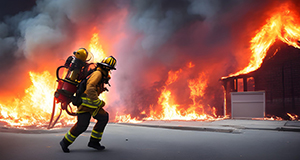
Wildfire swept through a small city devastating most of the homes and all the businesses. One of the destroyed businesses was an iconic hotel that was family-owned and operated for 125 years under long-term land leases. The hotel business included a popular restaurant frequented by hotel guests and local residents, and significant retail space that was fully leased at the time of the fire. Right before the fires, the land leases had been extended for multiple decades and the business was, by any measure, successful. Unfortunately, destruction of the hotel was total; there was nothing physical left. Arxis was retained to quantify the financial loss to the business owners.
How Do You Define Loss?
When a business is destroyed there are two potential definitions of loss: loss of income and loss of value. Lost income is relevant when the business can and will be rebuilt and will eventually resume normal operations. Loss of value is relevant when either the business will never resume operations or there are circumstances that make it impossible for the business to ever return to pre-disaster operations. If the business never resumes operations the value immediately before the fire must be determined and, generally, that is the loss since it has no value after the fire. If the business will resume altered or minimal operations the business must be valued before the fire and valued after resumption of operations to determine the loss of value. Any scenario requires access to historical financial records for the business, and the development of extensive projections.
Arxis Analysis:
In the case of the hotel, both methods (loss of income and loss of value) were considered. Multiple elements made the decision difficult. First, the owners’ emotional devastation of seeing a family’s efforts, through several generations, completely destroyed in a matter of minutes. The unique memories, décor, furniture, and all records of that history contained within the physical walls of the buildings had been reduced to ashes. The current owners were elderly and plans to pass the business to the next generation that were in place before the fire were now in question. The future owners were not certain they wanted to assume the risks and challenges of rebuilding.
A second complication was the local government. The city indicated that they saw this event as an opportunity to re-zone the land to change the authorized use away from redevelopment as a hotel/restaurant. They also made clear that the permitting process would be very complex as the current code requirements were very different than when the buildings were built 125 years ago. Even if they were allowed to rebuild the hotel, it would have to be based on entirely new designs and architecture. Further, it might be a few years before the zoning issues were resolved.
The most significant assumption in a business loss calculation is always the future expectations for the business. In this case, the questions were monumental but had to be resolved long before several factors could be known or even knowable. If the assumption was that the hotel owners were going to just “walk away,” the business would be valued at the date of the fire. This was certainly the easiest path. If, however, the owners decided to try to rebuild, multiple more assumptions were necessary such as the eventual zoning, timing of the zoning decisions, ongoing costs during the waiting and rebuilding period, date of eventual re-opening, and the period of time it would take to restore the financial activity after re-opening to where it would have been, but for the fire. The decision was to calculate the loss under both scenarios assuming it would re-open as a hotel.
Result:
The loss of business value was relatively easy to determine once the issue of destroyed financial records was overcome. The second calculation (lost income) was complex and involved probability analysis and, of course, assumptions that could be easily challenged. The loss period ended up being so far into the future that the present value of projected future business income was near zero. Therefore, lost business income ended up being essentially the same as lost business value. Several years on, the local government still has not allowed any construction. The assumptions used in the lost income calculation have proven to be accurate.
